Safe outdoor wiring for a snowflake projector
A snowflake projector draws little power, but it spends weeks outside in rain and snow. Seven wiring rules keep the power side of it safe, and none of them costs much.
Why a small light still needs care
A snowflake projector draws little power. The LYHOPE is rated at 6 W and the Govee H7071 at 20 W, so the danger rarely comes from the projector itself.
It sits in the connections. A plug adapter lying in a puddle or an indoor cord left in the snow is where outdoor decorations turn risky.
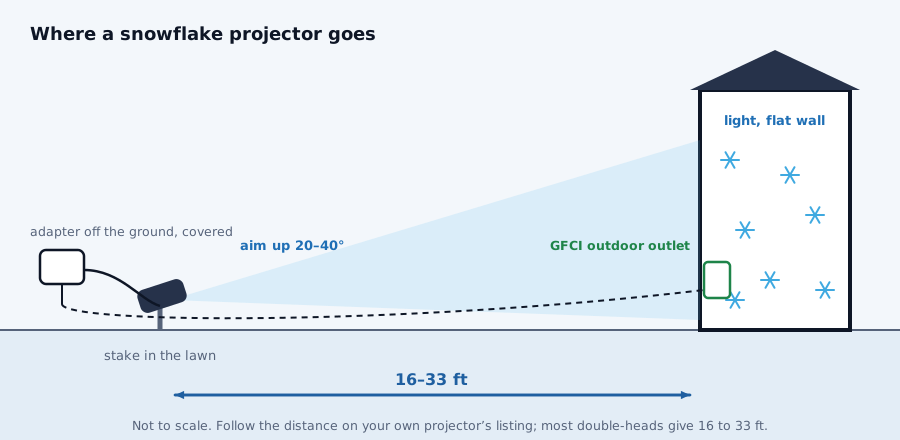
The figure shows where the rules below lead. The projector stands on a stake in the lawn, the adapter sits off the ground under cover, and the power comes from a GFCI outlet.
Rule 1: plug into a GFCI outlet
A GFCI (ground-fault circuit interrupter) cuts the power when current leaks to ground, through water or through a person. The National Electrical Code requires GFCI protection on the outdoor receptacles of homes.
Older outdoor outlets may lack it. Look for test and reset buttons on the outlet or a GFCI breaker in the panel, and press test before the decorations go up to make sure it trips.
The Electrical Safety Foundation International and the CPSC give the same advice for outdoor decorations. If no GFCI outlet is in reach, have one added rather than running a cord out of a window.
Rule 2: use outdoor-rated cords only
An outdoor-rated cord carries a “W” in the code printed on its jacket, such as SJTW. Indoor cords are not made for wet ground and frost, so leave them inside.
The cord should also be rated for the load, which for one or two projectors is small. The bigger issue is length, because the leads on these projectors are short.
- GUSODOR SW-TY-002: 16.4 ft power cord
- Forlivese triple-head and LYHOPE: 9.8 ft
- Brightown topper: 8 ft, and it belongs indoors anyway
Rule 3: keep the adapter dry and off the ground
Most projectors are better sealed than their power supply. The GUSODOR pairs an IP65 projector with an IP44 plug, and the LILNIAGY an IP65 housing with an IP44 adapter.
The LYHOPE listing says outright that its adapter is not waterproof. Put every plug connection in a weatherproof connection box or under an in-use (“bubble”) outlet cover, raised off the ground.
A projector is only as tight as its weakest part. Our guide to IP44, IP65 and IP67 ratings explains what each number promises and where the plug fits in.
Rule 4: route cords where they can’t get hurt
- Don’t run a cord through a closed door or window, where it gets pinched
- Don’t staple or nail through a cord
- Keep plug-and-cord joints out of puddles and snow drifts
- Run cords along edges, away from footpaths and the snow shovel
Snow adds its own trouble. A low projector and its cord can disappear under a drift, so check the setup after every storm and clear the connection box first.
Rule 5: read what the safety listing covers
Look for a UL or ETL mark on the product or the adapter. Several snowflake projector listings claim it for the adapter or plug only, so read the wording closely.
The LYHOPE lists a UL-certified 13.5 V adapter, and the Brightown topper a UL-certified plug with transformer. The LILNIAGY spec table says UL listed without naming the part.
A low-voltage design like the LYHOPE’s keeps household voltage at the outlet end, and only 13.5 V runs down the lead to the projector. That is sensible, but the adapter itself still has to stay dry.
Rule 6: let a timer switch it off
Unplug the projector, or let a timer switch it off, when nobody is home and at night. A timer does it without anyone having to remember.
The GUSODOR offers a 6-hours-on, 18-hours-off cycle plus a 2, 4 or 6-hour timer by remote, and the Forlivese and LYHOPE run the 6 and 18 cycle from a button. Switch these on at dusk, because the cycle starts counting the moment you press it.
When power comes back after a cut, the cycle starts over, which can leave the projector running in daylight. Our guide to timers, remotes and apps covers that quirk in detail.
Rule 7: aim at your house and nowhere else
Point the projector at your own wall. Never point a projector skyward or at aircraft, into a neighbor’s windows or at the eyes of drivers on the street.
The projectors in our lineup are LED, not laser. Laser projectors are regulated as laser products, and the FAA is the authority on anything that lights up the sky near aircraft.
A safety check before the first night
- Press test on the GFCI outlet and confirm it trips and resets
- Inspect cords and adapters for cracks, cuts or melted spots
- Seat the adapter in a weatherproof box or under an in-use cover, off the ground
- Set the timer at dusk, or plan to unplug at bedtime
- Check the aim from the street and from your neighbor’s side
If the GFCI keeps tripping or the projector won’t start, check the connections for water first. Our troubleshooting guide goes through the likely faults one by one.
Where the stake, base or wall bracket goes is covered in our setup and mounting guide. A good spot keeps the cord short and the adapter close to a covered outlet.
For the shortlist of the safest snowflake projectors we recommend, see the homepage. Its before-you-buy tips cover cords and covers as well, and the top pick explains why the GUSODOR leads.
Low voltage at the projector
The LYHOPE runs at 6 W from a 13.5 V low-voltage adapter that the listing calls UL-certified, and it holds pick 5 as the lowest price. It is rated only IP44 and its adapter is not waterproof, so give it a weatherproof outlet cover.