How far a snowflake projector should sit from the wall
Distance is the one setting you control on almost every snowflake projector, and it decides how big, sharp and bright the flakes look. This guide turns the listings’ numbers into a spot on your lawn.
The rule of thumb, 16 to 33 feet
Most double-head snowflake projectors on Amazon want to sit between 16 and 33 ft from the wall they light. That is the range the LYHOPE listing gives, and the GUSODOR seller names 33 ft (10 m) as its best distance.
Inside that window you trade size for sharpness. Move closer and the pattern shrinks into small, crisp flakes; move back and it spreads across the house while every flake turns softer and dimmer.
The gap between the projector and the wall is the throw distance. It is the main setting you control on a cheap model, because most of them have a fixed lens and no focus ring at all.
Why distance changes the picture
Light from a projector spreads in a cone. The inverse-square law says that when the distance doubles, the same light covers four times the area, so each patch of wall gets a quarter as much.
That is why a projector that looks bright on a garage door at 15 ft can look faint across a whole house front at 30 ft. Nothing is broken; the same light is spread thinner.
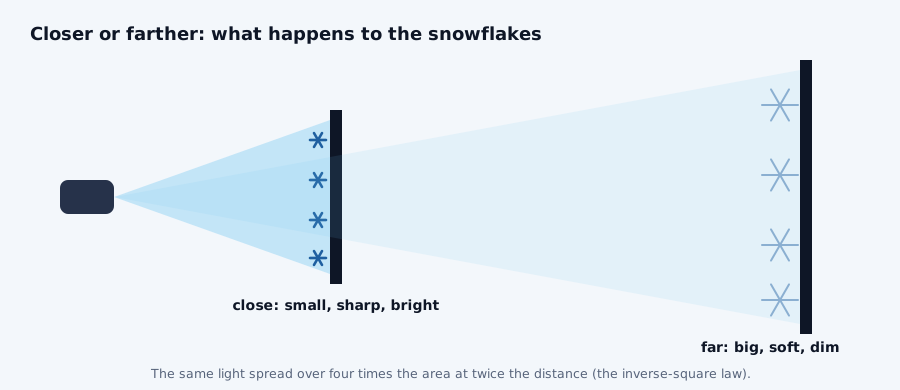
The lens adds a second effect. A fixed lens is sharp over one band of distances and soft outside it, so a projector pushed far past its rated range gives you bigger flakes that are also blurrier.
What each projector’s listing says
Sellers rarely publish lumens, so the distance on the listing is the most useful clue to how far a model can reach. The figures below come from the Amazon listings and, for the Govee, from Govee itself.
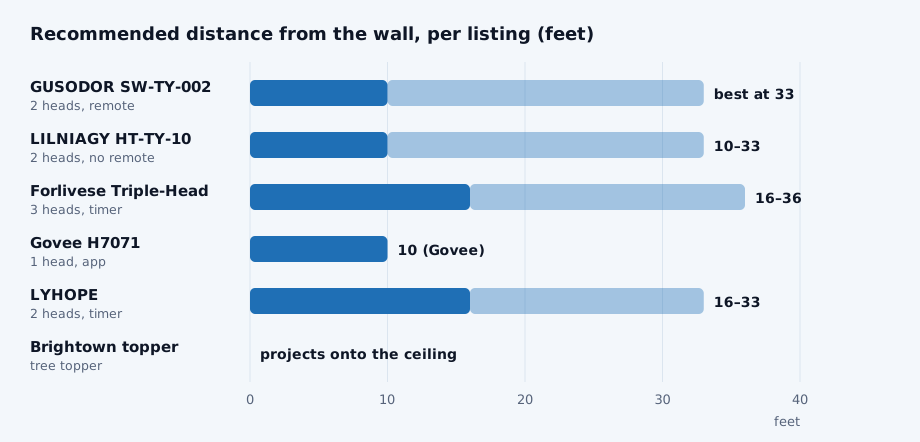
| Projector | Recommended distance | Rated coverage |
|---|---|---|
| GUSODOR SW-TY-002 | About 33 ft (10 m) | 70 to 350 sq ft in Amazon’s summary, 30 to 500 in the bullets |
| LILNIAGY HT-TY-10 | Not stated | Unlisted (owner reports reach about 400 sq ft) |
| Forlivese triple-head | 16 to 36 ft | 235 to 521 sq ft |
| Govee H7071 | About 10 ft (3 m) | Not stated |
| LYHOPE | 16.4 to 33 ft | Not stated |
| Brightown topper | Projects onto the ceiling | 21 to 53 sq ft on the ceiling |
Two models sit at the ends of the scale. The Forlivese triple-head is rated for the widest range, 16 to 36 ft, and its three heads fill more wall at the far end than a double-head can.
The Govee sits at the other extreme. Govee recommends about 10 ft for its 20 W focusing-lens projector, and owners say the figures blur once it moves farther from the house.
The GUSODOR listing contradicts itself on coverage, so read both of its numbers loosely. Our GUSODOR SW-TY-002 review goes through the claims, and every model sits side by side in the comparison table.
Match the distance to the wall you want lit
Start from the wall, not the projector. Pace out the yard in front of it and decide whether you want one feature lit brightly or the whole front washed in a looser pattern.
- A garage door or an entry: the near end of the range keeps the flakes small and bright, and the Govee is designed for about 10 ft
- A single-story front: the middle of the 16 to 33 ft range that most double-heads quote
- A wide or two-story house: the far end, ideally with three heads or two projectors, because one double-head spread that thin turns dim
- A room indoors: a few feet from the wall or ceiling, as our guide to a snowflake projector indoors explains
Head count matters as much as distance once the wall gets wide. Our guide to double or triple-head projectors explains when a third head earns its place over a second projector.
Angle, the hidden half of distance
A projector on a lawn stake sits low and aims up at the wall. The steeper that angle, the more the flakes near the top stretch into ovals, while the ones near the ground stay round.
Backing the projector away flattens the angle and evens out the shape. Lifting it onto a table base or a low garden wall does the same job in a shallow front yard.
The power cord sets a limit too. The GUSODOR has a 16.4 ft cord, while the Forlivese and LYHOPE leads are 9.8 ft, so a distant spot may need an outdoor-rated extension cord and a covered connection.
Stakes, bases and wall brackets each change where the projector can stand. Our guide on setting up and mounting a snowflake projector walks through the options, including the pilot hole a stake needs in frozen ground.
Fine-tuning on the first night
- Wait for full darkness, because dusk light washes the pattern out
- Switch off the porch light and any lamp aimed at the wall
- Start at the near end of the listed range and step back a few feet at a time
- Stop when the pattern reaches the edges you want and the flakes still look crisp
- Mark the spot, so the stake goes back in the same hole after a storm
If the flakes still look fuzzy at the right distance, the wall or the lens may be to blame. Our guide to sharper snowflakes covers dark surfaces, a fogged lens and stray light.
A light-colored, flat wall gives the most back, whether it is white siding, stucco, a garage door or a pale fence. Dark brick and glass swallow much of the light at any distance, and trees break the pattern up.
For a ranked shortlist with the distance of each model, see our pick of the best snowflake projector for most homes. The which-type section on the homepage sorts them by the job they do.
For a typical front wall
The GUSODOR SW-TY-002 is rated for about 33 ft and has the longest cord in our lineup at 16.4 ft, so it reaches the back of most yards without an extra cord. Its coverage claim differs within its own listing, so judge it by the wall, not the number.