One, two or three heads on a snowflake projector
Head count is the first thing a snowflake projector listing shouts about, and it decides how much wall you can light from one spot. More heads mean more coverage, not a brighter picture, and the right number depends on your house.
What a head is
A projection head pairs one LED with a patterned film and a lens, and a small motor turns the pattern so the flakes drift. Each head throws its own circle of snowflakes onto the wall.
More heads give you more circles side by side, not a brighter single beam. Most snowflake projectors on Amazon have two heads, a few have three, and the single-head models range from cheap units to the Govee H7071.
None of these are lasers. They are LED projectors, and several listings share a maker and differ mainly in brand name, color or head count.
The lineup by head count
| Projector | Heads | Light source | Coverage per the listing | Control |
|---|---|---|---|---|
| Govee H7071 | One | 20 W LED | Not stated | App, Alexa, Google Assistant, Matter |
| GUSODOR SW-TY-002 | Two | 12 LED beads | 30 to 500 sq ft (Amazon’s summary: 70 to 350) | RF remote, two timer modes |
| LILNIAGY HT-TY-10 | Two | 12 LED beads (spec table: 8 light sources) | Not stated; owners report about 400 sq ft | None |
| LYHOPE | Two per the bullets (spec table: 1 light source) | 6 W | Not stated | Button timer |
| Forlivese triple-head | Three | 18 LED beads | 235 to 521 sq ft | Button timer |
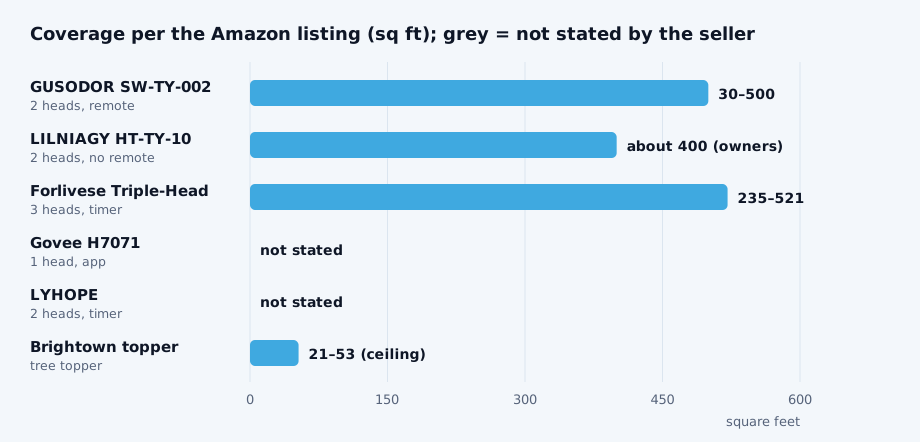
The chart plots the top of each listing’s range, and grey bars mark models whose seller gives no figure. Coverage claims are loose, so read them as a rough ranking rather than a measurement.
Where two heads are enough
A double-head covers a garage door, an entry or a single-story front from the 16 to 33 ft most listings quote. The GUSODOR and LILNIAGY heads each turn through 360°, so you can spread the two circles apart or stack them on one feature.
Double-heads are also where the choice is widest. Three of the six projectors we compare have two heads, and all three sit in the lowest price band, under $30.
What separates them is control rather than coverage. The GUSODOR adds an RF remote and two timer modes, and the LYHOPE has a button timer, while the LILNIAGY has neither.
Our guide to timers, remotes and apps weighs those controls up. For a house you will light every evening for weeks, a timer saves more effort than an extra head.
When a third head pays off
The Forlivese triple-head spreads 18 LEDs over three heads and is rated for 235 to 521 sq ft at 16 to 36 ft. That is the widest rated range in our lineup.
A third head helps on a long ranch front or a two-story wall, where two circles leave the ends dark. With more LEDs in total, it also lets you stand the projector farther back before the pattern thins out.
The trade-offs are control and reliability. The Forlivese gets by with one button and a daily 6-hours-on, 18-hours-off timer, with no remote, and some owners say units died or switched off 10 to 20 minutes after dark.
Part of its reviews were merged from garden lights, so read them with care. Our GUSODOR vs Forlivese head-to-head compares it with the top double-head round by round.
Two double-heads or one triple-head?
Two cheap double-heads give you four circles and two separate aiming points, so you can light both ends of a wide house. You also have a spare if one of them fails.
The cost is wiring. Two projectors mean two adapters to keep dry and off the ground, and power at two positions in the yard.
Their timers also count from the moment each one is switched on. Plug both into one outdoor-rated cord and power them up together at dusk, and they stay in step.
One triple-head keeps everything on one stake and one cord. It suits a yard where the projector can only go in one spot, such as a narrow strip of lawn in front of the house.
What about one head?
A single-head projector throws one circle. The Govee H7071 is the notable one, a 20 W LED with a focusing lens, 20 pattern discs you swap by hand and a recommended distance of about 10 ft.
That makes it a projector for one feature lit brightly, such as a garage door, rather than a whole front. Owners describe it as bright up close and blurrier as it moves back, which fits its short rated distance.
Sharpness depends on more than head count. Our guide to why snowflakes look blurry covers the lens, the wall and stray light, and the projection distance guide explains how far each type should sit.
Heads or strings of lights?
A projector of any head count lights a wall with moving flakes after a few minutes of setup. It does not outline a roofline or wrap a tree the way strings of lights do.
If you are torn between the two, our guide to a projector or string lights sets the effort and the effect side by side. Nothing stops you from using both on the same house.
How to choose
- One head: a single feature at close range, with app control on the Govee H7071
- Two heads: a garage door, an entry or a single-story front, and the widest choice of cheap models
- Three heads: a wide or two-story wall lit from one spot, in the middle price band
- Two double-heads: a very wide house where you can run power to both ends
Every model with its head count, coverage and controls appears among our snowflake projectors compared on the homepage. The full list of picks has a card for each, with the triple-head at pick 3.
For a wide wall from one spot
The Forlivese spreads 18 LEDs over three heads and is rated for 235 to 521 sq ft at 16 to 36 ft. It has a button timer but no remote, and some owners report reliability problems, so check it the night it arrives while returns are easy.